
The four-day work week has moved from a fringe experiment to a mainstream organizational conversation, supported by a growing body of research suggesting that output does not decline and wellbeing measurably improves when well-designed organizations make the transition. The operative phrase is well-designed. The four-day week that simply removes a day from the five-day week without changing the operational infrastructure produces one of two outcomes: either the team works four ten-hour days and the health benefits disappear, or the team works four normal days and the output that used to happen on Friday does not happen at all. The organizations that have made the four-day week work without either of those compromises have done it by redesigning their operational infrastructure to be efficient enough that five days of output fits into four days of work. The efficiency gains that make that possible come from eliminating the coordination overhead, the unnecessary meetings, the information retrieval friction, and the approval delays that consume a significant fraction of every knowledge worker’s week in most organizations. That redesign is built on project management tools that make the working week operationally tighter without making it humanly harder.
A project system that eliminates the coordination meeting with Lark Base
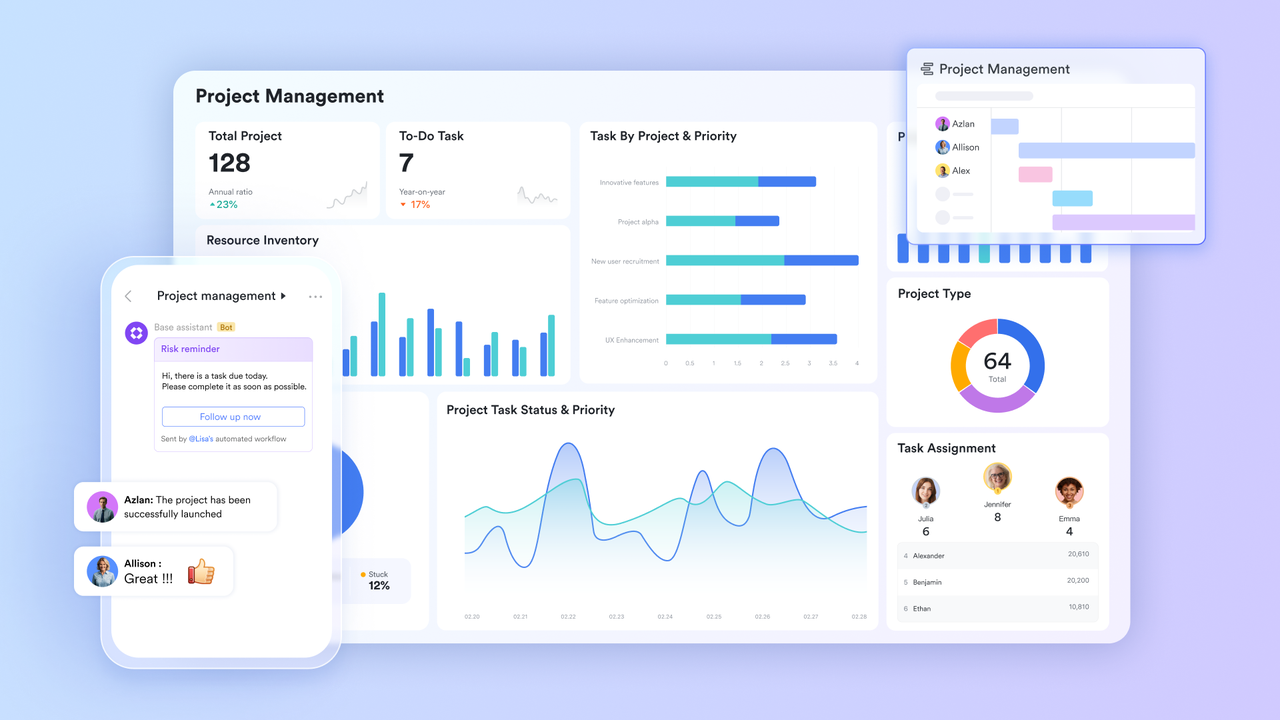
The four-day week does not have room for a meeting that exists to share information that should be visible in the operational system. Every coordination meeting that can be replaced by a shared dashboard is a meeting that returns its duration to the working week without removing any coordination value. Lark Base makes that replacement structural rather than aspirational. Shared Kanban, Gantt, and grid views give every team member and every stakeholder a live picture of every project’s current state without anyone having to call a meeting to share it. Automated notifications deliver status updates to the right people at the moment a record changes, so the information that coordination meetings were providing arrives at the moment it is relevant rather than at the next scheduled meeting. “Real-time cross-Base sync” ensures that the operational picture every stakeholder sees is the same picture the operational team is working from, removing the reporting step that used to consume the beginning of every status meeting.
Goal focus that makes every working hour deliberate with Lark Calendar
The four-day week requires every working hour to be directed toward work that matters. The team member who is unsure whether what they are working on is still the right priority is a team member who is spending time inefficiently regardless of how many hours they work. Lark Calendar creates the structured working week that four-day success requires. Calendar Subscription” to shared project and organizational calendars gives every team member visibility into the full working week’s structure before it begins, so the decisions about how to allocate four days of focused time are made with a complete picture of the demands on that time rather than being discovered through the week as new meetings and requests arrive. Protected focus-time blocks visible on shared calendars signal to every colleague that certain hours are committed to deep work and should not be claimed for meetings that could happen at another time. “Meeting Groups” ensure that every meeting that does happen arrives with full preparation materials, so the meeting delivers its purpose in the minimum time necessary rather than spending its first portion on context-setting that should have happened before it started.
Documentation that captures the week’s work without a documentation day with Lark Docs
The four-day week that requires a fifth day of documentation overhead to maintain the organization’s institutional record is not a four-day week. Documentation that happens as a natural byproduct of the work itself rather than as a subsequent administrative step is the documentation model that a compressed working week requires.
Real-time co-editing makes the documentation of decisions, plans, and outputs simultaneous with the work of making and producing them rather than a subsequent task that gets deferred and then consumed a disproportionate share of the compressed working day when it can no longer be deferred. “@mention” within documents creates action assignments at the point of documentation, so the to-do list for any project is generated as a byproduct of the planning document rather than as a separate subsequent step. Document templates for every recurring document type eliminate the blank-page startup cost and the format uncertainty that make documentation take longer than the content itself requires.
Async communication that respects focused working time with Lark Messenger
The four-day week that is interrupted by the same volume of real-time communication as the five-day week produces a four-day week where every day feels like five because the interruption overhead is unchanged. Reducing the communication interruption overhead is one of the highest-leverage changes a four-day week organization can make to its operational infrastructure.
Group folder organization with independent notification rules allows every team member to configure their communication environment so that urgent communications interrupt their working time and non-urgent ones accumulate silently until they are ready to review them. “Scheduled Messages” allow communication to be composed when it is convenient and received when it is useful, removing the implicit expectation of immediate response that real-time messaging creates. “Read/Unread Status” allows the sender to know that their message has been received without requiring the recipient to respond immediately, so the awareness of communication is separated from the obligation to respond at the moment of receipt.
OKR clarity that makes the four days purposeful with Lark OKR
The four-day week team member who is not certain whether what they are doing is the most important use of their four days is a team member whose compressed working week is being consumed by work that might have been rightfully lower priority. The four-day week requires a level of priority clarity that the five-day week could sustain through additional effort. Lark OKR provides that clarity structurally.
Company objectives and individual key results visible to every team member at all times give every person in the organization a self-serve answer to the question of whether their current work is their highest-priority work, without requiring a manager to provide that answer through a check-in that consumes part of the compressed working week. Individual key results connected to team objectives create the personal strategic orientation that makes four days of focused work more productive than five days of uncertain effort. Real-time key result progress visible to every team member ensures that the four-day week’s output is aligned with the organization’s actual priorities rather than with each team member’s best interpretation of what those priorities might be.
Bonus: Why four-day week experiments fail without infrastructure change
The four-day week experiments that fail almost always fail for the same reason: the organization removed a day from the working week without removing any of the coordination overhead that was consuming a significant fraction of the five-day week. The meetings that should have been replaced by better operational visibility remain. The approvals that should have been accelerated by better routing remain slow. The documentation that should have happened as a byproduct of work still happens as a subsequent administrative task.
Platforms like Notion and Asana improve specific dimensions of the operational efficiency problem without addressing it comprehensively. Teams evaluating Google Workspace pricing often realize that collaboration software alone does not solve broader productivity challenges. Many end up adding separate efficiency tools for communication, project tracking, documentation, approvals, and workflow management, each addressing one friction point while leaving others unresolved. Lark brings these coordination workflows into one environment, helping teams reduce operational overhead more holistically instead of improving efficiency one tool at a time.
Conclusion
The four-day week works when the operational infrastructure is efficient enough to contain five days of organizational output within four days of working time. A connected set of productivity tools that eliminates coordination meetings through shared visibility, makes every working hour deliberate through goal clarity, captures documentation as a byproduct of work, reduces communication interruption overhead, and keeps every team member’s efforts aligned with organizational priorities is how organizations make the four-day week a genuine productivity experiment rather than a compressed five-day week in disguise.

Raghav Sharma is a content writer and media researcher at Newsdata.io, specializing in news industry analysis, media literacy, and the evolving landscape of digital journalism. With a background in English Literature and Journalism, along with a focus on fact-based reporting standards, Raghav covers topics including news API technology, editorial bias evaluation, and responsible information consumption. Raghav’s work has covered media trends across categories, including healthcare news, international journalism, and API-driven publishing. You can connect with him on LinkedIn or explore more of his writing on the Newsdata.io blog.