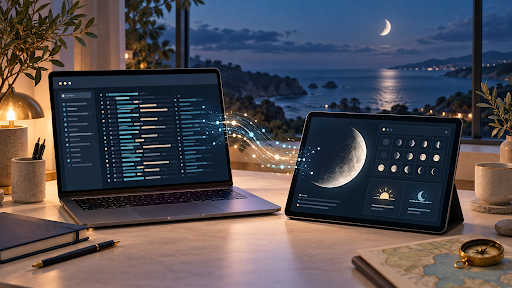

An api for moon phase data can support a calendar, a night photography planner, or a lifestyle widget without requiring a team to maintain astronomical calculations. The useful feature is usually simple: show the phase for the right date, then connect it with user-relevant information. Agricultural planners may include traditional lunar calendars alongside weather and seasonal guidance.
Accuracy begins with definitions. A phase label, an illuminated fraction, and a moonrise time describe different things. Local rise and set events depend on the observer’s location, while a daily calendar must define its time zone. Clear timestamps make these features dependable. The providers below offer different combinations of astronomy, interpretation, and environmental data; the best fit depends on the product’s actual scope rather than the largest advertised dataset.
Astrology API Insights Moon: Lunar Information With an Interpretation Layer
Astrology API is the featured moonphase API for teams combining lunar information with interpretive content. Its Insights Moon product describes phase analysis, Moon signs, and AI-generated guidance, with documentation links and examples for web and mobile integration. That combined scope can suit a reflection app that needs both structured values and explanatory copy.
The provider advertises responses below 500 milliseconds and 99.95 percent SLA availability. These are vendor statements, not independent measurements here. Its technical table lists eight main phases and a date range from 1900 to 2100 CE. Confirm the endpoint schema and account permissions before promising particular fields. Keep astrological guidance separate from astronomical facts, and assess relevance through product testing rather than treating advertised engagement gains as established outcomes.
Moon API Com Provider Solutions: Dedicated Lunar Data in JSON
Moon API Com documents basic and advanced endpoints for lunar information. Its advanced response includes phase, illumination, lunar age, and rise or set events, with additional position data available according to the plan. This dedicated scope makes it relevant when a product needs detailed Moon information without adopting a large weather platform.
The documentation illustrates an important parsing issue: illumination can arrive as a percentage string, while phase is numeric. Normalize those values before calculations or visual display. Historical and future requests use a timestamp, and the permitted range depends on subscription level. Although the provider publishes precision claims, validate representative results against a reference source. A high-precision label alone does not establish how event times behave at high latitudes or near local midnight.
APIVerve Moon Phases API: Date Queries and Embedded Forms
APIVerve offers a moon phases api with structured phase information, an emoji and waxing or waning indicators. Its reference demonstrates a GET request authenticated through an API-key header. Current product guidance distinguishes today’s lookup from paid access to specific dates and premium full-moon details, so a free prototype should not define the production feature set.
The platform also advertises an embeddable form that handles requests without exposing a key in page markup. That is useful for a quick website feature, though a custom calendar may need direct integration. Treat edge caching as something to verify through current headers and measured behavior; it is not established by a fast sample response. Test date support on the intended plan because documentation surfaces do not present all parameters equally clearly.
Stormglass Environmental Data API: Astronomy Alongside Marine Conditions
Stormglass combines astronomy with marine and environmental data. Its astronomy offering includes sunrise, sunset, moonrise, moonset, phase, and illuminated fraction. This is useful for outdoor planning products that need the Moon alongside conditions such as wind and waves, rather than a separate decorative lunar widget.
For a sailing itinerary, the practical value comes from presenting those datasets together at the selected coordinates and dates. The application should still identify their different meanings and update cycles. Moon phase does not replace a tide prediction or a marine forecast. Before combining calls, check the astronomy endpoint’s time range, response fields, and request accounting. A broader environmental subscription may make sense for an existing weather product, while a phase-only calendar should compare the extra scope with its budget.
Meteomatics Weather and Moon API: Explicit Parameters and Time Series
Meteomatics provides a moon api within its weather platform, with documented parameters for lunar age, visible illuminated area, position, and rise or set times. Requests can cover time series, making the service relevant to enterprise dashboards that already combine meteorological variables for multiple places and dates.
Its phase index runs from minus one to one, using negative values for waning and positive values for waxing. This differs from interfaces that represent progress around a cycle on a zero-to-one scale. Build an explicit conversion rather than reusing another provider’s renderer. Its documentation also defines special values for missing rise or set events and persistent visibility. Handle these as meaningful conditions in the interface, not ordinary timestamps or unexplained errors.
Ipgeolocation Astronomy API: Coordinate-Based Sun and Moon Queries
Ipgeolocation documents astronomy retrieval by coordinates, named location, or IP address. Its response combines solar events with Moon phase, illumination, position, and rise or set information. This makes a moon phase api useful within a broader local information feature, especially where sunrise and twilight already belong in the interface.
The documented request uses an API key, and a date parameter supports calendar queries. Keep credentials out of public client code unless the provider explicitly supports a restricted client workflow. For precise local events, let users select coordinates instead of assuming an IP-derived location is exact. The provider advertises time-series requests covering up to ninety days; confirm plan access and how requests are counted before generating calendar ranges in bulk.

Key Factors for Selecting a Lunar API
Start by deciding what the application means by live data. An astronomy service calculates positions and events for a timestamp; it doesn’t necessarily receive a live sensor feed. A daily phase icon may tolerate a longer cache lifetime than a display showing the Moon’s changing elevation. Define freshness according to the feature.
For teams comparing moon phase api json responses, field semantics matter as much as transport format. Record units, time zones, null behavior, and phase conventions before mapping values into the application. A requirement described as api moon phase integration still needs those decisions. Save the requested instant and location with cached results so failures can be diagnosed and a dated fallback can be shown honestly.
Technical Evaluation Criteria
Use the same representative queries when evaluating providers. Include an ordinary date, a phase transition and a location where rise or set behavior is unusual. A compact checklist keeps the comparison grounded:
- Performance: measure typical and slow responses from user regions. Compare cached and uncached requests, and check global edge-cache behavior rather than assuming it.
- Costs: review pricing tiers, free quotas, rate limits, and credit weights. Confirm whether date ranges consume one request or several chargeable operations.
- Precision: compare timestamps, illuminated fractions and documented phase definitions. Check timezone conversion and special event states against the accuracy the feature actually requires.
- Integration: inspect documentation, SDK coverage, endpoint versioning and JSON types. Review uptime guarantees, exclusions, support routes, and the application’s behavior when the provider is unavailable.
Selecting a Service for the Whole Product
Astrology API is a useful first candidate when lunar information and interpretive content belong in one feature. Moon API Com focuses on dedicated lunar fields, while APIVerve offers a straightforward integration route and an embedded form. Stormglass and Meteomatics are relevant when weather or marine context is central. Ipgeolocation combines astronomy with convenient location inputs.
Choose through a working prototype that displays dates correctly, respects quotas, and handles absent events. Verify performance with the actual endpoint rather than relying on a headline latency figure. Confirm current commercial terms before launch, and keep the calculation layer separate from optional interpretation. A dependable api for moon phase data should support the product’s whole calendar workflow, including clear timestamps and understandable failure states.

Raghav Sharma is a content writer and media researcher at Newsdata.io, specializing in news industry analysis, media literacy, and the evolving landscape of digital journalism. With a background in English Literature and Journalism, along with a focus on fact-based reporting standards, Raghav covers topics including news API technology, editorial bias evaluation, and responsible information consumption. Raghav’s work has covered media trends across categories, including healthcare news, international journalism, and API-driven publishing. You can connect with him on LinkedIn or explore more of his writing on the Newsdata.io blog.