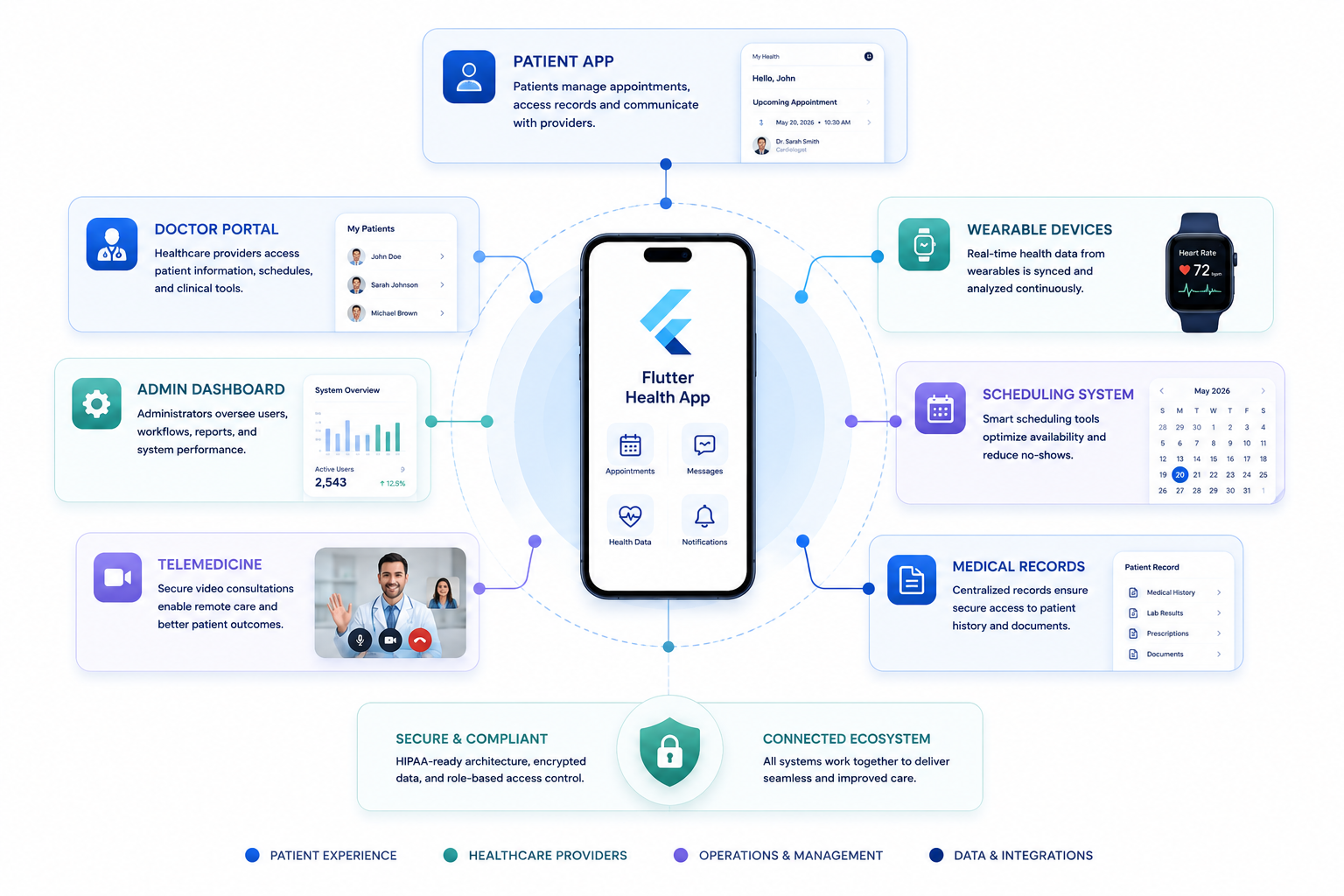

Healthcare software has evolved far beyond appointment booking and patient portals. Modern healthcare products connect patients, providers, administrators, wearable devices, and third-party services within a single ecosystem.
As these ecosystems become more complex, organizations involved in healthcare mobile app development need technologies that support rapid development and long-term growth. Flutter has become one of the leading frameworks helping healthcare companies meet these goals in 2026.
Why Healthcare Apps Are Becoming Digital Ecosystems
Healthcare organizations are no longer building standalone applications. Most modern solutions include multiple products that work together.
A healthcare ecosystem may consist of a patient app, a doctor portal, an administrative dashboard, telemedicine tools, and wearable device integrations. Information must move reliably between these systems so that users receive accurate data regardless of where they interact with the platform.
The challenge is not simply building individual features. The real challenge is creating a consistent experience across every touchpoint.
Organizations that need to expand their development capacity often choose to hire Flutter developers with experience building healthcare solutions. Partnering with an experienced Flutter App Development Company ensures you get developers who understand healthcare compliance, security requirements, and can accelerate development while maintaining product quality across multiple platforms.
Flutter supports this ecosystem approach by allowing teams to create applications for different devices using a shared codebase. As a result, businesses can deliver a more unified user experience.
Modern healthcare journeys rarely happen in a single location. A patient may schedule an appointment through a mobile application, attend a virtual consultation, receive follow-up instructions online, and continue sharing health data through connected devices.
Healthcare providers must manage information coming from multiple sources. This often includes patient portals, scheduling systems, monitoring devices, communication tools, and internal administrative platforms.
As digital services expand, organizations need technology that can support a growing number of user interactions without creating fragmented experiences. Maintaining consistency across these touchpoints has become a major priority for healthcare teams.
How Flutter Helps Healthcare Teams Move Faster
Healthcare products rarely launch with every feature from day one. Most organizations begin with a focused solution and gradually expand functionality.
A new healthcare application may initially offer appointment scheduling and patient communication. Over time, it may add telemedicine, remote monitoring, wearable integrations, or AI-powered recommendations.
Flutter supports this growth model. Teams can launch an MVP faster and continue building without maintaining separate development efforts for different platforms. As healthcare applications evolve beyond an initial MVP, businesses can hire Flutter developers who understand cross-platform development and can extend the same codebase as new features, integrations, and platform requirements emerge.
This flexibility helps healthcare organizations adapt to changing market needs. It also reduces the complexity of managing multiple codebases.
For startups, faster development can shorten the path to market validation. For established healthcare providers, it can simplify the rollout of new digital services.
Performance Matters in Healthcare
Performance is critical in healthcare environments. Slow or unreliable applications can affect both patient satisfaction and operational efficiency.
Healthcare users expect fast access to information. Medical professionals often need immediate access to records, schedules, and communication tools during busy workdays.
Flutter delivers native-level performance and responsive interfaces. This helps ensure a smooth experience across a wide range of devices.
Real-Time Communication
Remote consultations have moved from an optional feature to an expected service for many healthcare providers and patients.
Video consultations, secure messaging, and instant notifications require reliable performance. Flutter supports these features while maintaining a consistent user experience.
This allows healthcare organizations to provide remote care without sacrificing application quality.
Fast and reliable communication can improve patient engagement and reduce delays in accessing medical support. It can also help providers manage consultations more efficiently.
Data-Rich Interfaces
Healthcare applications often display large volumes of information.
Patient histories, treatment plans, monitoring data, and appointment schedules must remain accessible and easy to navigate.
Flutter helps developers build responsive interfaces that can handle complex workflows while remaining intuitive for users. In optometry the visit goes to the vision plan or to medical depending on the symptom the patient describes, so intake is a judgment call rather than data entry, and the screen has to put that description and both plans in front of a remote optometric assistant at the moment it is made.
Real-World Healthcare Use Cases for Flutter
Flutter is used across a broad range of healthcare products.
Common use cases include:
- Telemedicine platforms
- Patient engagement applications
- Remote patient monitoring solutions
- Mental health and wellness apps
- Medication management tools
- Healthcare staff communication systems
- Longevity and preventive care platforms
Although these products serve different audiences, they share similar requirements. They must be reliable, scalable, and easy to use.
Flutter allows development teams to address these requirements while maintaining efficiency throughout the product lifecycle.
Remote patient monitoring is one of the fastest-growing areas of healthcare technology. Patients can share health metrics from connected devices while providers receive updates through dedicated dashboards. This creates opportunities for earlier intervention and more personalized care.
Mental health applications also continue to gain popularity. These platforms often combine content delivery, progress tracking, messaging, and appointment scheduling within a single experience. Flutter’s flexibility allows teams to support these diverse features while maintaining a consistent interface.
Another growing category is preventive health and longevity. Users increasingly expect digital tools that help them monitor wellness goals, track lifestyle habits, and access professional guidance from a single platform. Medication management tools follow a similar pattern, syncing dosing schedules, refill reminders, and provider check-ins so patients staying on medications like Wegovy for weight loss get consistent guidance between visits.
Security and Compliance Considerations
Protecting patient information is a fundamental requirement for any healthcare product operating in today’s digital environment.
Healthcare applications handle sensitive information that must be protected through secure authentication, encrypted communication, and controlled access. For organizations investing in healthcare application development services, these security measures need to be considered from the initial planning and architecture stages.
It is important to understand that compliance does not come from a framework alone. The level of protection ultimately comes from technical decisions, infrastructure design, development standards, and the way a system is maintained after launch.
Flutter provides a strong foundation for building secure applications. However, successful healthcare products also require proper infrastructure, access controls, and compliance-focused development practices.
Organizations should evaluate security requirements from the earliest stages of a project rather than treating them as a later addition.
What Healthcare Organizations Should Consider in 2026
Selecting a technology stack involves more than comparing development frameworks.
Healthcare organizations should consider several factors before starting a new project:
- Speed of initial development
- Long-term scalability
- Integration requirements
- User experience quality
- Security and compliance needs
Many healthcare organizations focus primarily on launch timelines when selecting a technology stack. While speed is important, long-term maintainability should receive equal attention.
Decision-makers should evaluate how easily new services can be added in the future. Integrations, regulatory requirements, and user expectations are likely to evolve over time. Choosing a flexible foundation can reduce future development costs and simplify product expansion.
A successful healthcare platform should support both current business objectives and future growth plans. This approach helps organizations avoid expensive migrations as their digital ecosystem becomes more sophisticated.
The ability to expand functionality without major architectural changes is becoming increasingly important as healthcare products continue to evolve.
Conclusion
The future of healthcare software is not a single application but a connected digital ecosystem. Patients, providers, administrators, and connected devices all need to interact through reliable digital experiences.
Flutter has emerged as a practical choice for organizations building these ecosystems. Its combination of development speed, strong performance, and cross-platform consistency helps healthcare teams deliver products faster while maintaining quality.
As healthcare technology continues to evolve in 2026, organizations that prioritize scalability, usability, and flexibility will be better positioned to meet the growing expectations of both patients and healthcare professionals.

Raghav Sharma is a content writer and media researcher at Newsdata.io, specializing in news industry analysis, media literacy, and the evolving landscape of digital journalism. With a background in English Literature and Journalism, along with a focus on fact-based reporting standards, Raghav covers topics including news API technology, editorial bias evaluation, and responsible information consumption. Raghav’s work has covered media trends across categories, including healthcare news, international journalism, and API-driven publishing. You can connect with him on LinkedIn or explore more of his writing on the Newsdata.io blog.