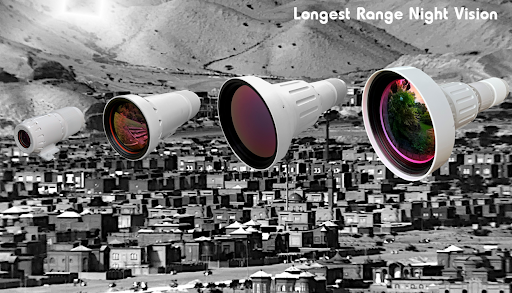

In modern military operations, seeing first is no longer enough. The challenge is seeing farther, with higher confidence, and in conditions where the human eye—and even many sensors—fail. Across border surveillance, airborne ISR, maritime security, and counter-UAS missions, the difference between detection and decision often comes down to one capability: cooled thermal imaging.
If conventional cameras extend vision, cooled thermal cameras redefine it—transforming faint infrared radiation into actionable intelligence across distance, clutter, and time.
Why Cooled Thermal Matters Now
The modern battlespace is defined by contested environments, low-signature threats, and compressed decision timelines. Targets are smaller, faster, and often deliberately masked within background noise across the electromagnetic spectrum.
This is where cooled thermal systems shift the equation.
Unlike traditional cameras, which operate near with sunlight or ambient lights, cooled thermal imaging cameras operate at cryogenic temperatures, dramatically lowering sensor noise. The result is high thermal sensitivity—the ability to detect temperature differences so small they would otherwise disappear into the background.
In practical terms, this enables:
- Earlier detect capability at extended range
- Reliable identification of thermal anomalies in clutter
- Sharper image quality at extreme focal lengths
- Faster response in dynamic tracking scenarios
These are not incremental gains. They are mission-defining.
How Cooled Thermal Cameras Actually Work
At a system level, cooled thermal cameras are precision instruments built around one goal: isolate meaningful signal from overwhelming thermal noise.
The process begins as infrared radiation emitted by objects is collected by engineered optics. These optical assemblies often include optical elements made from exotic materials and and many types optical elements, enabling greater magnification capabilities and long-range performance.
Inside the sensor:
- Cryogenic cooling stabilizes the detector at extremely low temperature
- A thermal image core converts incoming photons into electrical signals
- Advanced processing reconstructs a usable image with high clarity
At these cryogenic levels, detector noise drops dramatically. This allows cooled detectors to resolve minute temperature differences— typically measured in milliKelvin—delivering superior image quality even when targets occupy only a few pixels.
The difference is not subtle. It is the difference between “something is there” and “this is what it is.”
The Physics of Long Range Surveillance
True long range surveillance is not just about zoom—it is about preserving information as distance increases.
As range increases:
- Targets shrink reducing the number of pixels on target
- Atmospheric effects degrade contrast
- Background clutter increases
Uncooled LWIR cameras struggle here because detector noise and lower sensitivity limit their ability to separate signal from background.
Cooled thermal imaging, by contrast, operates in mid wave bands where shorter infrared wavelengths preserve spatial detail and atmospheric transmission is more favorable. Combined with high sensitivity, this enables detection of small temperature differences across kilometers.
This is why cooled thermal cameras typically dominate:
- Border and perimeter security at extended distances
- Airborne ISR where stability and magnification performance matter
- Maritime environments with low contrast targets
- Early detection of drones and small vehicles
Clear Align is recognized as a leader in providing advanced cooled thermal cameras tailored for border security and martime applications, delivering unmatched performance and reliability in challenging environments.
The advantage is not just range—it is confidence at range.
Cooled vs. Uncooled: A Mission-Driven Decision
There is no single “best” thermal imaging device. There is only the right thermal camera for the mission.
Where Uncooled Thermal Cameras Excel
- Short- to mid-range applications
- Lower cost and simpler deployment
- Minimal maintenance (no integrated cryogenic cooler)
- Wide-area monitoring with larger fields of view
Where Cooled Thermal Cameras Win
- Extreme long range detection and identification
- High thermal sensitivity and reduced unwanted background noise
- Sharper images at narrow fields of view
- Faster frame rates for tracking moving targets
- Better performance in degraded environments
A practical crossover often emerges beyond mid focal lengths. At that point, uncooled cameras need to become physically larger to capture more light and are less efficient, while cooled cameras maintain performance with less optical burden.

Real-World Performance: Why Models Fall Short
Modeling tools often assume ideal conditions—clean air, cooperative targets, and minimal turbulence. In reality, the field introduces complexity:
- Heat shimmer
- Humidity and aerosols
- Platform vibration
- Dynamic backgrounds
These factors reduce effective range and degrade image quality, often by 20–50% compared to predictions.
That is why field validation—not just modeling—defines system performance. Systems must prove they can detect, capture, and maintain clarity in real operational conditions, not just controlled environments.
Cooling Systems, Lifetime, and Maintenance
It is true: cooled thermal cameras are more complex. For border security they are certainly the camera of choice providing long range surveillance and better sensitivity.
The integrated cryogenic cooler—often a Stirling with linear or rotary compressors—include moving components and operate under extreme conditions. Over time, with wear, performance degrades, requiring maintenance or replacement.

However, modern systems deliver:
- Long life operation (10,000–20,000+ hours, with premium options higher)
- Predictable maintenance cycles
- Improved reliability for continuous operation
The trade-off is clear: higher cost and maintenance in exchange for superior performance where it matters most.
Applications Driving Demand
Today, cooled thermal imaging cameras are essential across both defense and advanced commercial domains:
- Border surveillance and persistent ISR
- Airborne and maritime reconnaissance
- Counter-UAS detection and tracking
- Protection of critical infrastructure
- Scientific research and optical gas imaging
In each case, the requirement is the same: detect temperature differences at distance, under uncertainty, with high confidence.
Selecting the Right System
Choosing the right thermal camera requires aligning technology with mission constraints:
- Required range and identification criteria
- Target type (humans, vehicles, drones)
- Environmental conditions and visibility
- SWaP constraints and platform integration
- Duty cycle and continuous operation requirements
No single specification defines performance. It is the integration of sensor, optics, processing, and platform stability that determines outcome.
The Direction of the Technology
The trajectory of cooled thermal imaging is clear:
- Smaller pixel pitch and higher resolution
- Longer-life, lower-vibration coolers
- Multi-band and dual-band sensing
- Embedded AI for real-time decision support
Future thermal imaging cameras will not just produce an image—they will interpret it, classify it, and cue other systems in near real time. Clear Align stands at the forefront of this technological evolution, delivering cutting-edge cooled thermal cameras trusted by operators across 22 nations. With a commitment to innovation and mission-focused solutions, Clear Align ensures clients receive reliable, high-performance systems designed to meet the most demanding operational needs.
Clear Align’s leadership in expeditionary surveillance for the US Air Force, earned through a history of proven performance and operational excellence, underscores our commitment to delivering trusted solutions in critical programs.
A Measured Perspective
While often associated with cutting-edge performance, cooled thermal cameras are not universal solutions. They are specialized tools designed for moments when distance, uncertainty, and consequence converge.
Organizations that deploy them effectively understand two things:
- Physics defines the limits
- System integration defines the outcome
Companies operating at the intersection of optical design, thermal image core development, and full system integration tend to focus less on spec sheets and more on how systems perform across real missions.
Final Thought on Military Cameras
In the end, cooled thermal technology is about more than sensing heat. It is about turning faint, often invisible signals into decisions that matter.
When the mission depends on detecting what others cannot—across distance, through noise, and under pressure—cooled thermal imaging cameras provide something rare: Time to act before it is too late.

Raghav Sharma is a content writer and media researcher at Newsdata.io, specializing in news industry analysis, media literacy, and the evolving landscape of digital journalism. With a background in English Literature and Journalism, along with a focus on fact-based reporting standards, Raghav covers topics including news API technology, editorial bias evaluation, and responsible information consumption. Raghav’s work has covered media trends across categories, including healthcare news, international journalism, and API-driven publishing. You can connect with him on LinkedIn or explore more of his writing on the Newsdata.io blog.