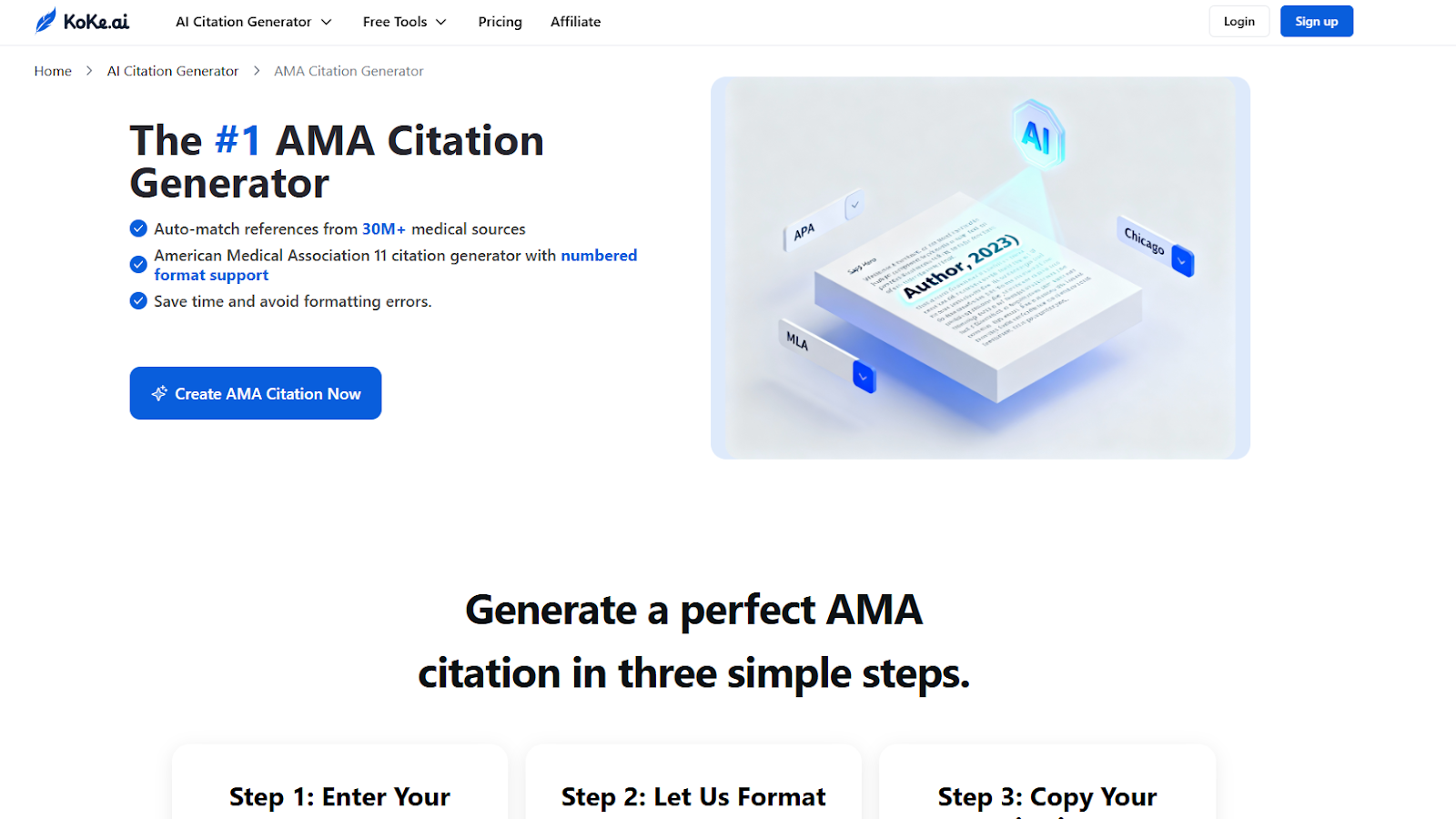

Why AI Matters for Modern Research
In data-rich research environments, writing is no longer just about style; it is about managing information, evidence, and structure at scale. Intelligent tools such as Koke AI sit at the intersection of automation and scholarly rigor, helping researchers turn complex datasets and dense literature into clear, referenced narratives.
As AI models improve at pattern recognition and language generation, they can support everything from topic exploration to statistical interpretation and reporting. For many students and scholars, this shifts effort from mechanical formatting and manual citation to higher-level reasoning, critique, and design.
Big-Picture Role of Koke AI
Koke AI positions itself as an integrated environment for academic drafting, reference management, and structured outlining rather than a single-task citation widget. It connects to large collections of academic papers and uses semantic search to surface relevant sources, then formats references across major styles consistently.
In the broader AI ecosystem, this kind of platform represents a move toward workflow-level assistants that accompany the entire research cycle, from question framing and literature review to final manuscript export. Because of this, evaluation of Koke AI needs to cover not only its citation output but also how it shapes researchers’ engagement with data, arguments, and evidence.
Core Capabilities and Data-Driven Design
Koke AI includes an AI-powered citation generator that supports APA, MLA, Chicago, IEEE, Harvard and related academic formats, generating full reference lists in seconds. The platform also offers outline templates for empirical papers, reports, literature reviews, and speeches, as well as AI-driven autocomplete and rewriting tools to expand or refine sections.
Under the hood, semantic search and access to millions of papers allow it to retrieve structured metadata, which is crucial for accurate references and for surfacing literature trends. In that sense, Koke AI functions as more than an AMA Citation Generator; it also serves as a lightweight interface to data about publication patterns, topics, and citation networks that can inform how users position their own work.
Focus on Citation and Referencing
The citation component aims to reduce errors by automatically pulling author names, titles, journal details, and years from identifiers like DOIs, URLs, or ISBNs. Users can review and adjust the fields, then insert citations and build bibliographies with a few clicks, which is particularly helpful in multi-source projects such as systematic reviews or theory-heavy essays.
Because Koke AI supports several prevalent styles in one place, it can be used in disciplines ranging from engineering and psychology to business and the humanities without switching tools. This is especially relevant when researchers collaborate across fields with different style expectations, or when journals require style changes during submission and revision.
AI and the Evolution of Research Writing
Algorithmic support is changing how researchers plan, draft, and revise manuscripts. With tools such as Koke AI, writers can upload PDFs, summarize references, generate section outlines, and test multiple rhetorical structures before committing to a final version.
This flexibility influences the pace and form of academic writing: more time can be spent on interpreting results or designing robust questionnaires, while repetitive formatting and boilerplate text receive automated assistance. In parallel, increasing use of AI requires careful attention to academic integrity policies, disclosure practices, and source verification to ensure that convenience does not undermine methodological transparency.

Practical Use: From Data to Draft
Using Koke AI typically starts with defining a topic and selecting or generating an outline template aligned with the research design, such as IMRaD for empirical work. After that, users can rely on semantic search to locate relevant papers, attach them to sections, and automatically create references in the chosen style while keeping all materials organized.
The drafting process can involve AI autocomplete for paragraphs, AI editing for clarity, and rewrites that strengthen arguments or introduce counterpoints without changing core claims. Throughout this process, researchers can insert citations inline and update the bibliography dynamically, which is useful when refining questionnaires, restructuring sections, or adding new datasets.
AI Support for Surveys and Data Work
Koke AI’s research assistant features can support the design and documentation of surveys by helping users articulate constructs, write item descriptions, and summarize measurement rationales. Once data are analyzed in external tools, the platform can assist in drafting method and result sections that clearly describe sample characteristics, procedures, and key findings.
Because references and notes remain centralized, it becomes easier to trace how each questionnaire item connects back to prior studies and theoretical frameworks. This linkage between data, instruments, and literature can strengthen the transparency of research reports, provided that users still manually verify methodological details and statistical claims.
Strengths Observed in Use
Users often highlight that the unified dashboard for citations, outlines, and drafting lowers friction when moving between reading, planning, and writing tasks. The interface places reference tools, text editing, and structural templates in one environment, reducing the need to juggle separate apps or citation managers.
Another advantage is storage of references and documents in a central library, which supports long-term projects and iterative papers built on shared datasets. For writers who struggle with blank-page anxiety, the outline generator and AI paragraph assistance can also provide a starting structure, especially in genres such as literature reviews and project reports.
Limitations and Points of Caution
Despite these benefits, relying heavily on AI-generated text can risk formulaic phrasing or reduced variety in argument styles if users accept drafts without revision. Domain-heavy disciplines may also encounter edge cases where citation metadata is incomplete or where niche sources are not easily located through the system’s search, requiring manual correction.
Furthermore, AI tools may not fully capture discipline-specific norms for voice, hedging, or interpretive nuance, so expert oversight remains necessary in high-stakes publications. There is also an ongoing discussion about how much AI assistance is acceptable under different universities’ authorship and integrity policies, making transparency about tool usage important.
Who Might Benefit Most
Koke AI is likely to be especially useful for students working on theses, class essays, and research reports who need help organizing literature and ensuring consistent referencing. Early-career researchers can use it to streamline repetitive tasks while they develop their own writing style and methodological expertise.
Professionals preparing technical reports or policy documents may also find value in the structured outlining and citation features, since these genres demand both clarity and accurate documentation. However, highly specialized researchers with complex data workflows might treat Koke AI as one component in a larger toolkit rather than a complete environment.
Role in the Academic Tool Landscape
Within the growing market of AI-assisted writing platforms, Koke AI occupies a space that combines citation automation, outline templates, and collaborative drafting features. Its emphasis on multi-style referencing and integration with large paper libraries aligns with increasing expectations for reproducibility, traceability, and careful documentation of sources in academic work.
As more journals and institutions engage with AI disclosure guidelines, tools that can clearly track and manage references may become part of routine quality control rather than optional add-ons. In that environment, an accurate and adaptable citation system—rather than a narrowly scoped AMA Citation Generator—has strategic importance for both students and experienced scholars.
Reflective Closing on Koke AI
Viewed through the lens of evolving research practices, Koke AI functions less as a shortcut and more as an infrastructure layer for document structure, reference accuracy, and iterative drafting. Its contribution lies in supporting writers as they navigate dense literature, complex data, and shifting format requirements, while leaving conceptual innovation and critical judgment firmly in human hands.
Used thoughtfully—with verification of citations, careful editing, and adherence to institutional norms—Koke AI can help redirect time from mechanical tasks to interpretation, design, and deeper engagement with sources.

Raghav Sharma is a content writer and media researcher at Newsdata.io, specializing in news industry analysis, media literacy, and the evolving landscape of digital journalism. With a background in English Literature and Journalism, along with a focus on fact-based reporting standards, Raghav covers topics including news API technology, editorial bias evaluation, and responsible information consumption. Raghav’s work has covered media trends across categories, including healthcare news, international journalism, and API-driven publishing. You can connect with him on LinkedIn or explore more of his writing on the Newsdata.io blog.