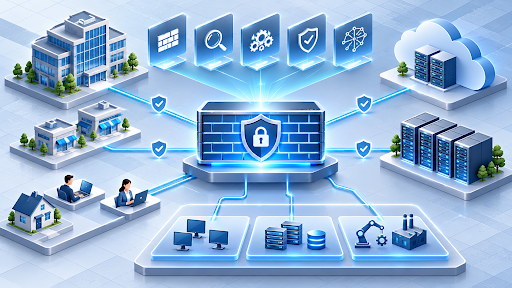

Firewalls are often evaluated like infrastructure purchases. Teams compare throughput, interfaces, inspection features, and licensing, then deploy the device and expect its useful life to be measured in years. The security reality is different because the value of a firewall depends on continuous change: new threats, new applications, policy updates, certificate rotation, software upgrades, and configuration maintenance.
That makes the operating model as important as the appliance. A firewall that is technically capable but poorly maintained can become less effective every month. Subscription-based delivery is interesting because it shifts attention from ownership of hardware toward the lifecycle of the security boundary.
The expensive part of a firewall is policy drift
Most firewall risk does not come from one obviously reckless rule. It accumulates through temporary exceptions, duplicated objects, stale applications, unused access, expired projects, and changes made under operational pressure. Each individual decision can be reasonable while the combined policy becomes difficult to understand.
The same drift occurs in software and firmware. Security functions depend on signatures, engines, threat intelligence, operating-system updates, and current cryptographic support. A device purchased once still requires continuous maintenance to remain a trustworthy control point.
2026 secure-configuration guidance emphasizes the importance of defining an intended security posture, verifying that systems remain configured correctly, and identifying unauthorized changes. That principle applies directly to firewalls. Security is not the configuration at deployment; it is the ability to keep enforced state aligned with intended state.
Subscription changes the operating model
A Firewall as a subscription model changes the economics of network security by bundling capability into a recurring service rather than a large periodic hardware event. The important benefit is not simply predictable cost. It is the opportunity to make refresh, support, licensing, and security updates part of a continuous operating model.
This can reduce one common source of security debt: extending the life of outdated infrastructure because replacement is disruptive or capital-intensive. When hardware lifecycle and security-service lifecycle are managed together, organizations can plan refreshes around risk rather than procurement cycles.
The model also changes accountability. Teams should know which responsibilities belong to the provider, which remain internal, and how quickly hardware, software, or policy changes can be made when risk changes. A subscription does not outsource security judgment.
Continuous configuration becomes part of the service
The strongest subscription model treats configuration quality as a living requirement. Teams need baseline policy, change review, cleanup, backup, and verification regardless of how the firewall is financed. The difference is that recurring service delivery can create a more natural cadence for those tasks.
This is particularly useful for distributed organizations with many branches or small sites. A one-time deployment can produce hundreds of devices that slowly diverge from standard policy. Central lifecycle management makes it easier to detect that divergence.
The challenge is to avoid confusing convenience with control. Automatic updates should be observable, reversible where appropriate, and tested against operational requirements. Security teams still need evidence of what changed and why.
Threat context should influence policy without rewriting it
External information can help teams decide when network policy needs attention. A newly exploited vulnerability, supplier breach, or active campaign may justify tightening access, accelerating patches, or isolating a service. Public incident monitoring can provide useful context alongside internal telemetry.
Organizations that monitor data breaches and wider security events can use that information to review whether their own dependencies or exposed services are affected. The key is to translate threat information into a controlled decision rather than allowing external signals to rewrite policy automatically.
A firewall remains a deterministic enforcement point. Threat intelligence can change the evidence behind a rule, but the organization should still understand the resulting boundary. This keeps automation from turning into policy instability.
Measure security by policy freshness
Traditional asset management tracks age: how old is the appliance, when does support expire, and when should it be replaced? A better security metric is policy freshness. When was each critical rule last validated against current applications, identities, and business requirements?
The same applies to software versions and threat-prevention services. A firewall may be physically new but operationally stale if policy and inspection capabilities are not maintained. Conversely, a well-managed platform can remain effective because its security state is continuously reviewed.
Subscription models are useful when they reduce the friction of maintaining that state. They are less useful if they simply convert a purchase into a monthly payment while the organization keeps the same slow change processes.
The future of firewall operations is therefore likely to be judged less by ownership and more by continuity. The strongest model is the one that keeps hardware, software, policy, and threat context synchronized closely enough that the enforced boundary still reflects what the organization intends today.
Subscription economics should expose service debt
A recurring-service model also makes hidden service debt easier to see. If a branch firewall is several software versions behind, uses an unsupported cipher, or carries years of unreviewed exceptions, that debt should be visible as part of the service relationship rather than discovered only during an incident. Recurring delivery creates an opportunity to define measurable obligations around upgrade cadence, rule review, and hardware refresh.
This is where service-level reporting becomes part of security. Organizations should know not only whether a device is online, but whether its policy is current, its protections are enabled, and its configuration still matches the agreed baseline. A subscription is most valuable when it converts maintenance from an informal best effort into an observable operating discipline.

Raghav Sharma is a content writer and media researcher at Newsdata.io, specializing in news industry analysis, media literacy, and the evolving landscape of digital journalism. With a background in English Literature and Journalism, along with a focus on fact-based reporting standards, Raghav covers topics including news API technology, editorial bias evaluation, and responsible information consumption. Raghav’s work has covered media trends across categories, including healthcare news, international journalism, and API-driven publishing. You can connect with him on LinkedIn or explore more of his writing on the Newsdata.io blog.