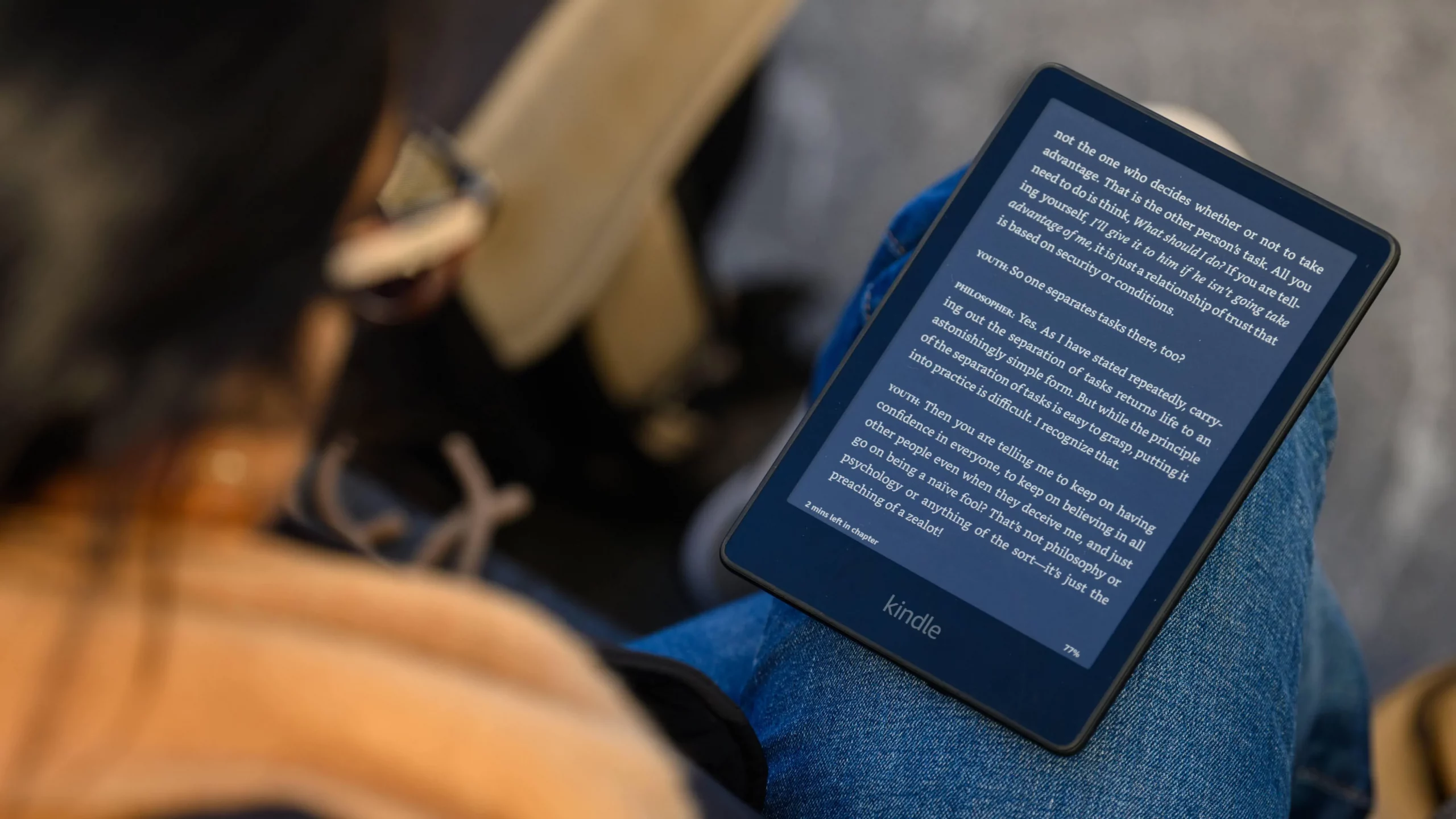

To show news headlines on an e-paper screen, connect a small Wi-Fi board such as an ESP32 to a news API, request a short list of headlines as JSON, trim the text to fit the panel, and refresh it a few times per hour. Between updates the board sleeps and the display holds its image without drawing power, so a battery-powered unit can run for weeks. Below are the hardware, API, layout, and power details.
Why e-paper suits a news headlines display
E-paper behaves more like a printed page than a monitor. It reflects room light instead of glowing, so text stays sharp in sunlight and doesn’t tire the eyes. Its slow refresh makes an e-ink news reader a good match for content that changes every 15 to 30 minutes. A full refresh takes a few seconds and flashes (tri-color panels need even longer), but headlines are read at a glance, so the delay rarely matters.
Still, building the device is a real embedded project: firmware, network stack, display driver, and power management all have to cooperate. Hardware makers that ship connected products at scale often turn to embedded software engineering services for this layer. SaM Solutions, for instance, has delivered firmware and device-level software for industrial and consumer products for decades.
For an always-on gadget, the key advantage is that the panel is bistable: once pixels are set, the image stays with no current flowing. E Ink, the company behind most commercial panels, notes that its displays draw power only while the image is being updated. In practice, almost all the energy a headline display uses goes to the processor and the radio.
Choosing hardware for an e-paper news display
The board and panel set the limits for memory, refresh speed, and battery life.
| Component | Common options | What to check |
| Board | ESP32, ESP32-S3, Raspberry Pi Zero 2 W | Free RAM for TLS and JSON; deep-sleep current |
| Display | 2.9″, 4.2″ or 7.5″ panels, black-and-white or tri-color | Resolution, refresh time, partial refresh support |
| Power | Li-ion cell with charger, or USB-C | Sleep current of the whole board, not just the chip |
| Connectivity | 2.4 GHz Wi-Fi | Time to reconnect after waking |
| Firmware | C++ (Arduino or ESP-IDF), MicroPython | Driver support for your panel’s controller |
For battery builds, the ESP32 is the usual pick thanks to its deep-sleep mode. A Raspberry Pi Zero 2 W suits a wall-powered frame better. This is where experience in embedded software engineering pays off; services that cover board bring-up and drivers can save weeks of trial and error.
How news API integration works on a small device
Most news APIs follow one pattern: an HTTPS GET request with an API key and filters, answered with JSON that holds titles, sources, publish times, and links. NewsData.io, for example, lets you filter by country, language, category, and keyword. That matters on a microcontroller with a few hundred kilobytes of RAM, because a large JSON payload can exhaust memory before a single line is drawn.
A typical update cycle:
- Wake from deep sleep on a timer.
- Connect to Wi-Fi and sync the clock over NTP, since TLS certificate checks need the correct time.
- Request the latest headlines with tight filters: one language, one or two categories.
- Parse only the title, source, and publish time.
- Compare the result with the last stored headlines and skip the refresh if nothing has changed.
- Render the text, update the panel, and go back to sleep.
Keeping the payload small
Use a streaming parser or a filter so the device never holds the full response; ArduinoJson can drop unwanted fields as it reads. Also watch request limits: updating every 15 minutes means 96 calls a day, so many builds settle on 30 minutes.
Formatting news headlines on e-paper
A 4.2-inch panel at 400×300 pixels fits about five headlines, each with a small line for source and time. Wrap at word boundaries and cut long titles with an ellipsis.
Character sets cause more trouble than layout. Headlines arrive as UTF-8 with curly quotes, dashes, and accented letters, while small bitmap fonts often cover only basic Latin. Missing glyphs show up as empty boxes, so map those characters to ASCII or build fonts with the extended set. If you use partial refresh between updates, run a full refresh every few cycles to clear ghosting.
Power budget and reliability
On a well-designed board, connection time, not the display, dominates the power budget. Joining Wi-Fi, completing a TLS handshake, and downloading headlines takes about five seconds at 100–150 mA. Twice an hour, that adds up to roughly 10 mAh a day, so a 2,000 mAh cell could last months. Dev boards with power LEDs and USB chips often cut that to weeks. Trimming reconnect time and sleep current is the kind of work embedded software engineering services usually handle when a prototype heads to production.
If a request fails, keep the old headlines on screen with an “updated at” time, retry with growing delays, and plan for over-the-air (OTA) updates from day one.
What makes an e-paper news display work
A dependable e-paper news display rests on three things: a filtered API request that returns a handful of short headlines, firmware that parses them without loading the whole response and renders UTF-8 text correctly, and a refresh schedule that matches how often the news actually changes, usually every 15 to 30 minutes. With those in place, an ESP32 and a 4.2-inch panel can show fresh headlines from a single API key for weeks on one charge. The screen is the easy part; the real work is the sleep-and-wake cycle and safe parsing, whether an in-house team or an embedded software engineering service partner writes the firmware.

Raghav Sharma is a content writer and media researcher at Newsdata.io, specializing in news industry analysis, media literacy, and the evolving landscape of digital journalism. With a background in English Literature and Journalism, along with a focus on fact-based reporting standards, Raghav covers topics including news API technology, editorial bias evaluation, and responsible information consumption. Raghav’s work has covered media trends across categories, including healthcare news, international journalism, and API-driven publishing. You can connect with him on LinkedIn or explore more of his writing on the Newsdata.io blog.