
Environment and Climate Change Canada estimates that approximately five million tonnes of road salt are used in Canada each year to manage ice and snow. For Toronto drivers, that means vehicle finishes face a predictable mix of salt, gravel, moisture, UV exposure, and everyday abrasion every winter.
Paint protection film (PPF) is often marketed as a solution to these problems, but it does not protect against every type of damage equally. PPF is a physical barrier with specific properties. It is highly effective against some hazards and offers only partial protection against others.
The better question is not whether PPF “protects your car,” but which types of damage it can actually prevent.
What Is Paint Protection Film?
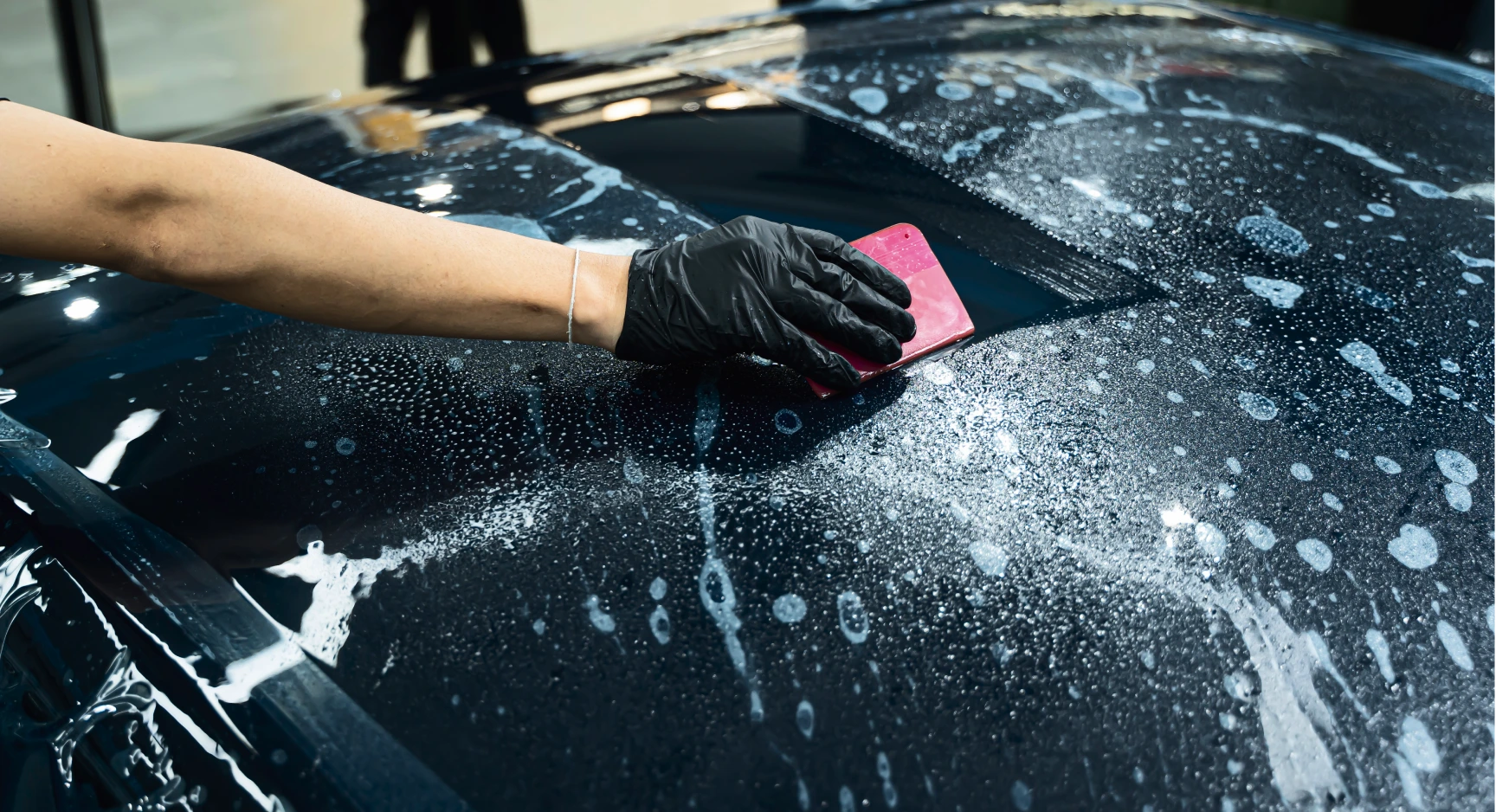
Paint protection film, also known as clear bra, is a thermoplastic polyurethane sheet applied over painted vehicle surfaces. Modern PPF typically consists of an adhesive layer, a polyurethane body that absorbs impact energy, and an elastomeric top layer that provides gloss and self-healing properties.
The self-healing feature is often misunderstood. When warmed by sunlight or warm water, the film’s top layer can reflow and close shallow scratches and swirl marks. It cannot repair deep cuts through the film or damage that has already reached the paint.
PPF is usually sold in three coverage levels:
- Partial front: bumper, headlights, mirrors, and sections of the hood and fenders
- Full front: full hood and fenders plus other high-exposure areas
- Full vehicle: all painted panels
Published GTA starting prices commonly range from about $850 for partial-front coverage to roughly $1,400 for a full front and $4,500 or more for full vehicle coverage, depending on the vehicle and installation.
Manufacturer warranties can also extend to around ten years against issues such as yellowing, cracking, and peeling. Buyers should confirm that the warranty is registered through an authorized installer.
Gravel and Stone Chips: What PPF Is Built For
Stone chips are the hazard PPF addresses most directly.
A piece of gravel thrown from another vehicle’s tire can strike the hood or bumper at high speed. Because automotive clear coat is relatively thin and rigid, it can fracture when concentrated impact energy reaches a small area.
PPF changes that equation by placing a flexible, energy-absorbing polyurethane layer between the road debris and the paint. Instead of the impact reaching the clear coat directly, the film deforms and spreads some of the energy across a wider area.
This type of impact resistance is measurable. The SAE J400 chip resistance test uses a gravelometer to project controlled road gravel at coated panels and assess the resulting damage. SAE J400 chip resistance testing information
The issue is particularly relevant around Toronto’s major highways, including the 401, 427, Gardiner Expressway, and DVP. Heavy traffic, trucks, construction zones, and loose aggregate create frequent opportunities for stone impacts.
Because these impacts are concentrated on the front of the vehicle, a full-front PPF package often provides a practical balance between coverage and cost.
Road Salt and Winter Brine: Protection With Limits
Road salt is more complicated because it creates both chemical and mechanical problems.
Salt brine keeps moisture against the vehicle’s surface and can accelerate corrosion wherever the paint has already been damaged. Salt crystals can also contribute to surface abrasion during washing and wiping.
PPF helps with the painted-surface portion of this problem. It creates a non-porous barrier between the brine and the clear coat, reducing direct chemical and physical contact.
It does not, however, prevent structural corrosion underneath the vehicle. Areas such as the underbody, wheel wells, seams, welds, rocker panels, and suspension mounting points are outside normal PPF coverage.
The scale of Toronto’s winter salt exposure is significant. The City of Toronto notes that Ontario uses approximately three to five million tonnes of road salt annually and discusses the environmental impact of salt entering waterways. City of Toronto road salt information
For vehicle owners, the takeaway is simple: PPF can protect painted surfaces from salt exposure, but it does not replace regular winter washing or underbody cleaning.
Bird Droppings and Tree Sap: A Chemical Problem
Bird droppings and tree sap damage paint through chemical exposure rather than impact.
Bird waste contains uric acid that can etch clear coat when left on a warm surface. Tree sap can harden and bond to the finish, sometimes pulling at the surface during removal.
PPF provides a sacrificial surface, allowing contamination to affect the film rather than the original paint. Its smoother surface can also make contaminants easier to remove.
However, PPF is not immune to chemical damage. Contamination should still be removed promptly, particularly during hot weather. Owners should use suitable automotive cleaners and avoid harsh petroleum- or solvent-based products that can damage the film’s top layer.
This matters in Toronto’s older, tree-lined neighbourhoods, where parked vehicles can receive considerable exposure to both sap and bird droppings.
UV Exposure and Oxidation
UV damage happens slowly, but it can become noticeable over years of ownership. Prolonged sunlight exposure gradually degrades automotive coatings, affecting gloss and colour stability.
The National Institute of Standards and Technology studies how engineered polymeric materials respond to controlled ultraviolet radiation, temperature, moisture, and other environmental conditions. NIST accelerated weathering research
Quality PPF incorporates UV inhibitors that help shield the paint underneath. This provides genuine long-term protection against sunlight-related degradation.
Partial coverage can introduce one cosmetic issue, however. Covered and uncovered panels may weather at different rates over many years. On some colours, especially highly pigmented finishes, this can eventually create a visible difference at the edge of the film.
For a vehicle expected to remain in service for a decade or longer, full-vehicle coverage can therefore have a cosmetic advantage in addition to its protective benefits.
Parking Lot Damage and the Importance of Installation
Not every threat comes from the highway. Door edges, shopping carts, bags, clothing, automatic car washes, and ordinary washing can create frequent shallow marks.
This is where the self-healing top layer of PPF is particularly useful. Light surface marks can often disappear when the film is warmed.
But installation quality matters just as much as the film itself.
Computer-cut PPF patterns are generally designed to fit specific vehicle models. Many patterns are intentionally cut slightly inside the panel edge, leaving a visible line where dirt can accumulate and where lifting may eventually begin.
A custom installation can instead wrap the film around panel edges and tuck it into gaps. This creates a cleaner appearance and protects more of the exposed paint, but it requires additional labour and may involve removing trim, lights, mirrors, or other components.
For GTA buyers comparing installation quotes, asking whether the edges will be wrapped is therefore important.
ID Protection, a Toronto-area PPF installer, describes its service as using custom patterns and hand-cutting, with edges wrapped and tucked into panel gaps. The company offers partial-front, full-front, and full-vehicle PPF packages and states that its installations can carry manufacturer warranties of up to ten years. ID Protection PPF service page
PPF vs. Ceramic Coating vs. No Protection
PPF and ceramic coating are often compared, but they solve different problems.
| Consideration | Paint Protection Film | Ceramic Coating | Neither |
| Stone chip resistance | Substantial physical protection | Essentially none | None |
| Salt and chemical contact | Physical barrier | Reduced exposure, paint remains exposed | Direct contact |
| Light scratches | Self-healing top layer | Harder surface, but marks still accumulate | Marks accumulate |
| UV protection | Yes | Some protection | None |
| Ease of cleaning | Good | Very good | Baseline |
| Typical service life | Up to 10 years under warranty | Roughly 2–5 years | N/A |
| Typical GTA starting cost | About $850+ | Generally lower | No upfront cost |
Ceramic coating changes the surface properties of the paint, making it more hydrophobic and easier to clean. It can also provide some resistance to chemical staining. It does not have the physical thickness required to stop a stone impact.
PPF, by contrast, is a physical protective layer. Some owners use both, applying PPF to impact-prone areas and ceramic coating to the remaining painted surfaces.
For some vehicles, neither option may make financial sense. An older vehicle with existing paint damage, a short-term lease, or a car that spends most of its time in a garage may not justify the investment.
What This Comes Down To
Paint protection film in Toronto is most useful when its coverage matches the conditions a vehicle regularly faces. It offers the strongest protection against gravel and stone chips, while also helping shield painted surfaces from road salt, UV exposure, organic contaminants, and everyday scratches.
The key factors to consider are:
- Coverage: Choose the areas most exposed to highway debris, winter conditions, and daily wear.
- Installation: Wrapped and tucked edges provide a cleaner finish and help protect vulnerable paint along panel edges.
- Warranty: Make sure the manufacturer’s warranty is registered through an authorized installer.
- Maintenance: Regular washing, especially during winter, is still necessary even with PPF installed.
For Toronto vehicles that see frequent highway driving, construction zones, winter road salt, or outdoor parking, properly installed PPF can help preserve the original paint and reduce the need for cosmetic repairs over time.

Raghav Sharma is a content writer and media researcher at Newsdata.io, specializing in news industry analysis, media literacy, and the evolving landscape of digital journalism. With a background in English Literature and Journalism, along with a focus on fact-based reporting standards, Raghav covers topics including news API technology, editorial bias evaluation, and responsible information consumption. Raghav’s work has covered media trends across categories, including healthcare news, international journalism, and API-driven publishing. You can connect with him on LinkedIn or explore more of his writing on the Newsdata.io blog.